10 Must-See Historic Churches in Melbourne CBD

Melbourne’s skyline is dominated by glass towers and busy streets, but scattered throughout the CBD are churches that predate much of the modern city.
Built during the early colonial years and the wealth of the gold rush, these buildings reflect the communities that shaped Melbourne — Anglican, Catholic, Presbyterian, Methodist, Lutheran and more. Some rise high above the streets with dramatic Gothic spires, while others sit quietly between office towers.
Join me as I walk through Melbourne’s CBD to visit ten churches that reveal a different side of the city. Along the way, you’ll see some of Melbourne’s most historic and architecturally impressive places of worship.
1. St Paul’s Cathedral — Flinders Street
Completed in 1891, St Paul’s Cathedral is one of Melbourne’s most recognisable landmarks. Designed in Gothic Revival style, it echoes the great cathedrals of Europe while occupying one of the city’s busiest intersections, directly opposite Flinders Street Station.
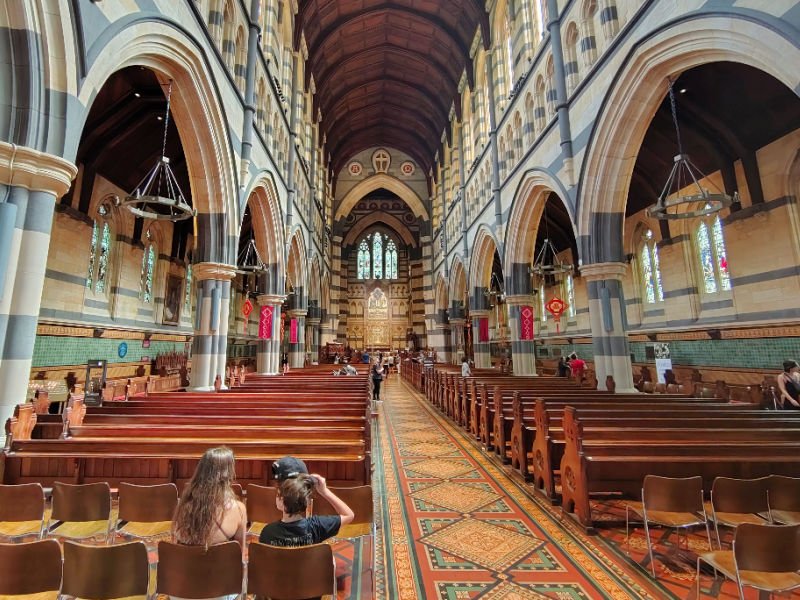
The cathedral’s distinctive twin spires were added in 1932 using sandstone from Sydney after the original local stone proved too weak to support the weight. Inside, tiled floors, sandstone walls, and towering organ pipes create a calm interior that contrasts sharply with the constant movement outside.
More than 130 years after its completion, St Paul’s remains Melbourne’s Anglican cathedral and continues to host major civic and religious events.
2. Collins Street Baptist Church — 170 Collins Street
Established in 1845, Collins Street Baptist Church dates back to Melbourne’s earliest years. The current Gothic Revival building, completed in 1862, reflects the confidence of a city transformed by the gold rush.
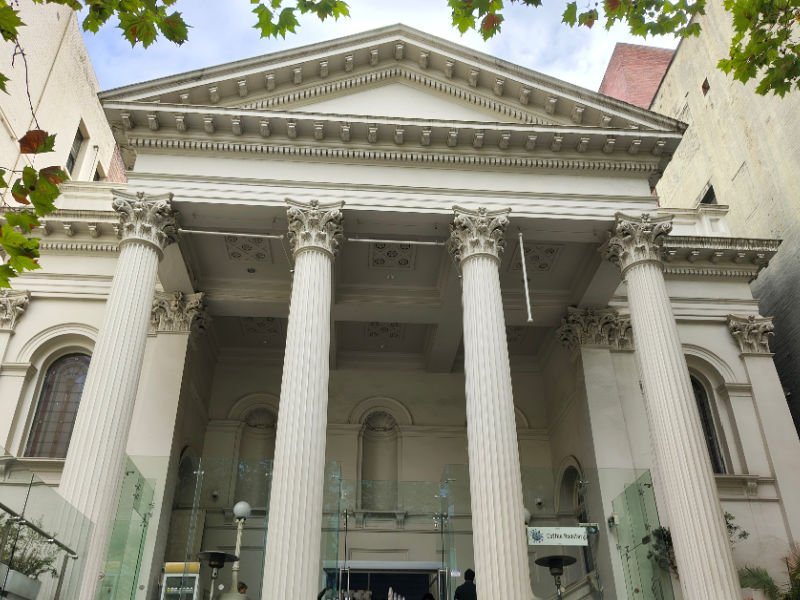
Remarkably, the church has remained in continuous use for more than 160 years, even as skyscrapers have risen around it. Located on what was once Melbourne’s most prestigious street, it stands as a quiet reminder of the role faith played in the city’s early civic life.
3. Scots’ Church — 77 Russell Street
Completed in 1874, Scots’ Church reflects the prosperity of Melbourne’s gold rush era and the influence of the city’s early Scottish community.
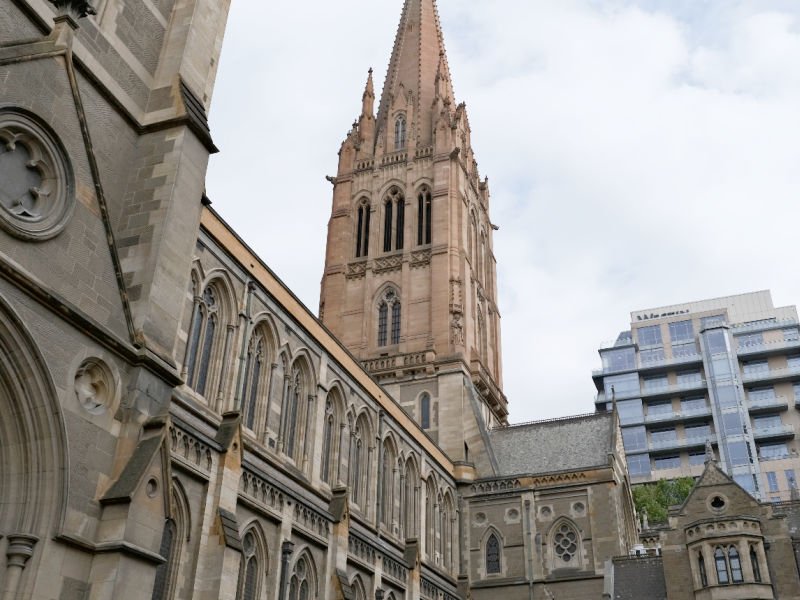
Its striking 120-metre spire once ranked among the tallest structures in Melbourne and remains a prominent feature of the skyline. Beneath the church lies a crypt containing the remains of several notable early figures in Victoria’s history. Scots’ Church is also known for its strong musical tradition and one of Australia’s finest pipe organs.
4. St Michael’s Uniting Church — 120 Collins Street
St Michael’s Uniting Church stands out for its distinctive Lombardic Romanesque design, an unusual style in Melbourne where Gothic architecture dominates many churches.
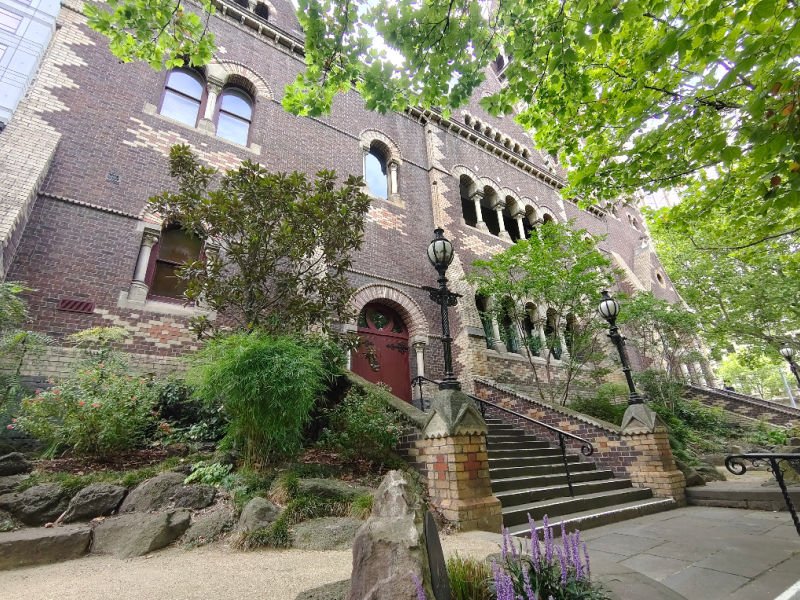
Completed in 1866, the building’s rounded arches and solid form give it a powerful presence along Collins Street. Originally established by the Congregational Church, St Michael’s developed a reputation for progressive thinking and open public debate. Today it remains an active place of worship surrounded by office towers and luxury retail.
5. German Lutheran Trinity Church — 22 Parliament Place
Trinity Church was built in 1856 to serve Melbourne’s growing German immigrant community during the gold rush.
Its modest Gothic design reflects the practical beginnings of many migrant congregations establishing themselves in a new city. Services were originally conducted in German, preserving cultural traditions far from home.
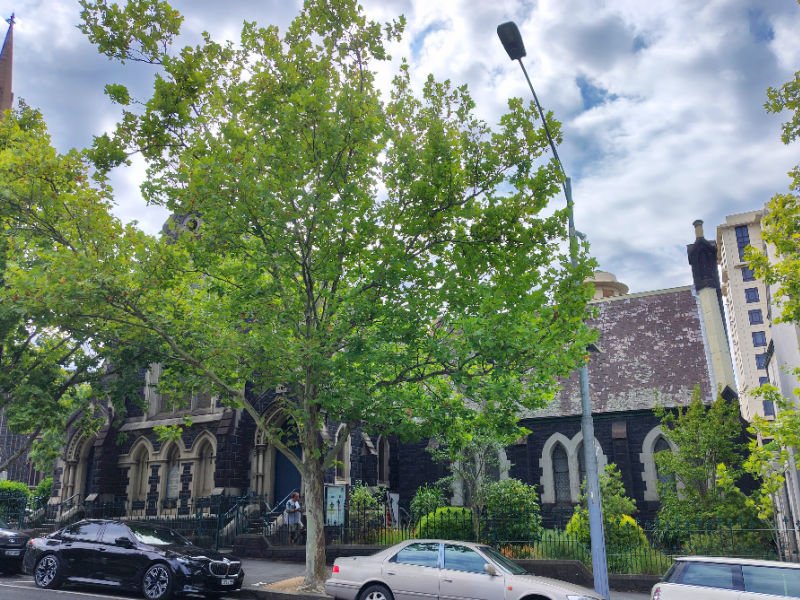
Located near Parliament House, the church highlights how closely faith and civic life were connected in colonial Melbourne.
6. St Patrick’s Cathedral — 1 Cathedral Place
St Patrick’s Cathedral is the largest church building in Australia and one of the finest examples of Gothic Revival architecture in the world.
Designed by architect William Wardell, construction began in 1858 and continued for decades before the cathedral was fully completed in 1939. Its spires rise more than 100 metres above the city, dominating the skyline from the eastern edge of the CBD.
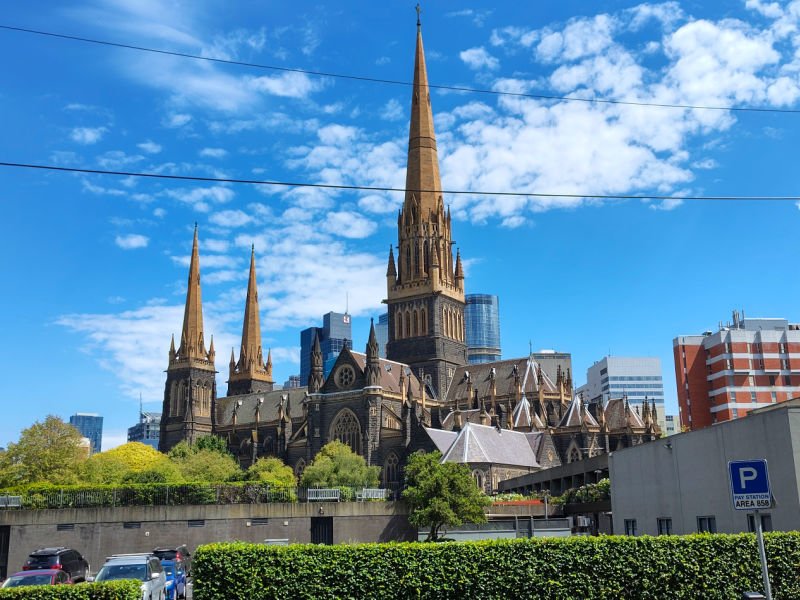
Inside, stained glass windows, stone carvings, and a vast nave create an atmosphere of grandeur and reflection.
The cathedral remains the spiritual centre of Catholicism in Victoria and hosted Pope John Paul II during his 1986 visit to Australia.
7. St Peter’s Eastern Hill — 15 Gisborne Street
Consecrated in 1848, St Peter’s Eastern Hill reflects Melbourne’s earliest years as a growing colonial settlement.
Built in a restrained Gothic style, the church was positioned on elevated ground overlooking the early town.
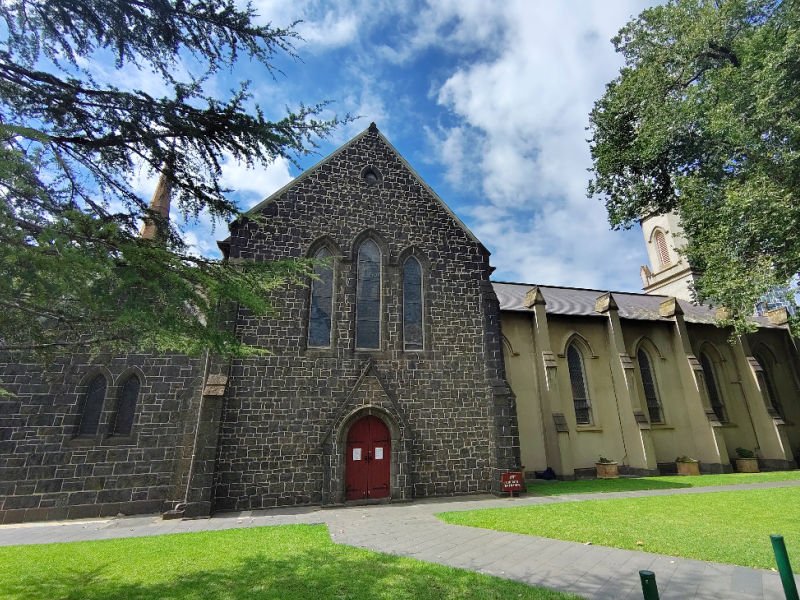
Over time it developed a strong association with social justice and community outreach, supporting Melbourne’s most vulnerable residents.
Today it remains an active parish and an enduring link to the city’s early foundations.
8. Wesley Uniting Church — 130 Lonsdale Street
Completed in 1858, Wesley Uniting Church became one of Melbourne’s most important Methodist centres during the gold rush years.
Its elegant spire and arched windows reflect the growing confidence of colonial Melbourne. Named after John Wesley, founder of Methodism, the church quickly developed a strong role in education, worship, and community service.
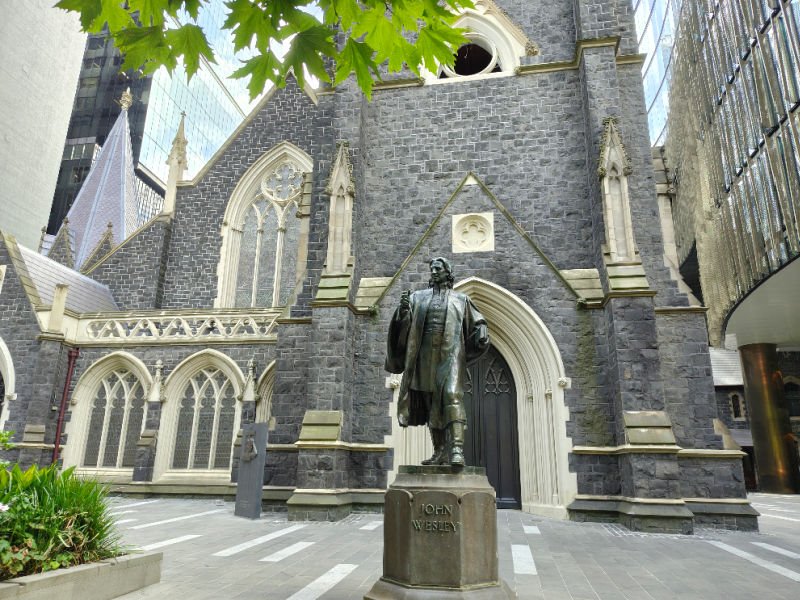
Its location near the theatre district attracted a diverse congregation that included workers, performers, and city residents.
9. St Francis’ Church — 326 Lonsdale Street
St Francis’ Church is the oldest Catholic church in Melbourne, with the first chapel established here in 1841.
The current church was completed in 1845 and later expanded as Melbourne’s Catholic population grew during the gold rush.
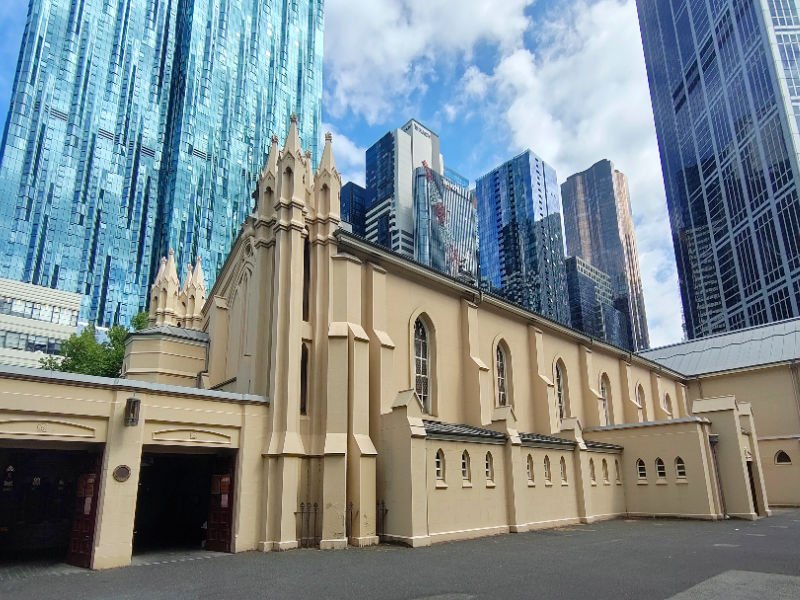
While the exterior is relatively simple, the interior features stained glass, ornate altars, and a peaceful atmosphere that feels far removed from the busy city streets outside.
For more than 180 years, St Francis’ has remained an important centre of Catholic life in Melbourne.
10. St James’ Old Cathedral — Corner King and Batman Streets
St James’ Old Cathedral is Melbourne’s oldest surviving church building, originally constructed in 1839 when the settlement was still in its infancy.
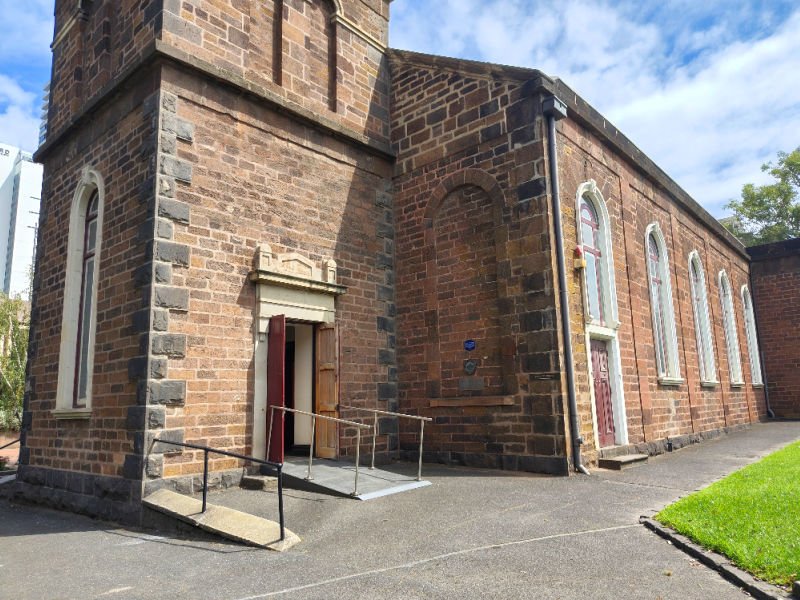
The building served as Melbourne’s first Anglican cathedral until St Paul’s was completed decades later. In a remarkable engineering effort, the entire structure was dismantled and relocated stone by stone in 1914 to make way for city development.
Today, surrounded by office towers and near Flagstaff Gardens, St James’ stands as a rare reminder of Melbourne’s earliest days.